
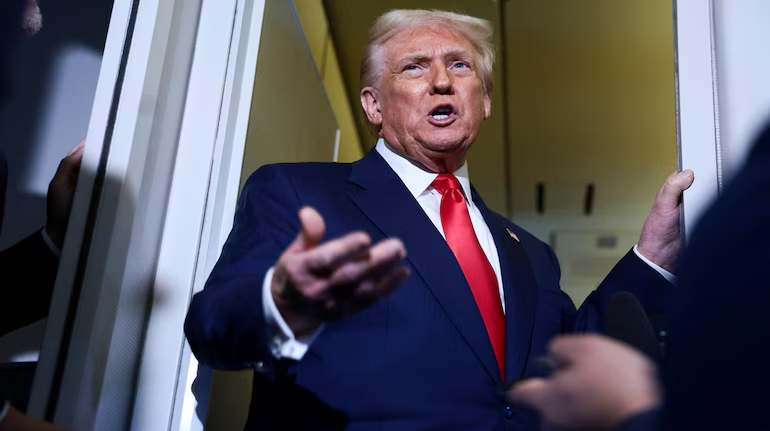
As the year draws to a close, there is little doubt that Donald Trump has dominated the global narrative like no other leader or event. From geopolitics to trade policy and economic ideology, Trump’s actions have reshaped headlines and challenged long-held assumptions about the Western economic order.
Few would have imagined, even a year ago, that the United States would impose its steepest tariffs in over a century, or that Washington would openly confront its closest allies in Europe, accusing them of what Trump has described as “civilisational erasure.” Equally unexpected has been Trump’s overt diplomatic outreach towards Russia, signalling a sharp departure from decades of entrenched Western alignment.
Beyond Trump: A Deeper Structural Shift
While Trump’s policies often appear disruptive and unconventional, many analysts argue that he is not the root cause, but rather a symptom of long-simmering systemic pressures within the Western economic model. Rising inequality, deindustrialisation, voter dissatisfaction, and the perception that globalisation has disproportionately benefited elites have been building for years.
These forces created fertile ground for a leader who challenges free-trade orthodoxy, global institutions, and the traditional rules of capitalism.
From Shareholder to Managerial Capitalism
Recent analysis, including coverage by the Financial Times, points to a significant shift underway in the US economy under Trump’s influence — a move away from pure shareholder capitalism toward a more managerial or state-influenced model. This approach prioritises domestic production, strategic industries, and employment over global efficiency and shareholder returns.
Trade barriers, industrial policy, and strategic tariffs are increasingly being used as tools to reshape supply chains and restore manufacturing strength at home, even at the cost of higher prices or strained international relationships.
What This Means for Global Markets
Trump’s resurgence underscores a broader transformation in how Western economies function and interact with the world. The era of frictionless globalisation is giving way to economic nationalism, fragmented trade blocs, and strategic competition.
Whether Trump remains in power or not, the underlying forces that enabled his rise — economic anxiety, political polarisation, and distrust of global systems — are likely to persist. For global markets, investors, and policymakers, this signals a long-term shift rather than a temporary disruption driven by one individual.
In that sense, Donald Trump is less an anomaly and more a reflection of the changing Western economic and political landscape.
